


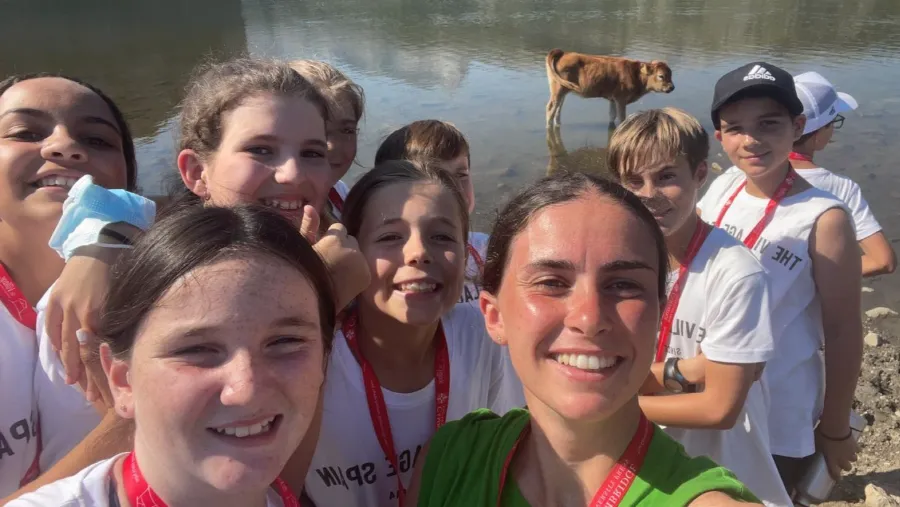
When parents assess an English camp for the first time, they often focus on the activities, the facilities or the programme. However, one of the factors that most influences whether learning is real or superficial is less visible: the role played by adults and coaches in the child's daily life.
Understanding how they support, correct, motivate and structure day-to-day life from the very first day is key to knowing whether a camp goes beyond entertainment and builds a truly immersive experience.
Why the adult is crucial in an English camp
In an immersion context, children do not learn English because “someone explains better”, but because someone is constantly accompanying them in real situations. The adult ceases to be a traditional teacher and becomes a linguistic and social guide throughout the day.
For parents of children, this nuance is fundamental: it is not about how many hours are scheduled, but about what kind of adult presence exists at every moment of the camp.

Coach or teacher: a difference that makes the result
The teacher: learning limited to the classroom
In many programmes, the adult acts as a classic teacher: explains, corrects exercises and evaluates. The problem arises when that figure disappears outside the class and English is no longer necessary for the rest of the day.
- English is associated with a specific moment.
- The group returns to its common language for daily life.
- The child separates “learning” from “living”.
The coach: continuous support in English
In a camp with real learning, the coach is present in activities, meals, games and daily life. Their role is not to deliver content, but to create a need for communication in English and support the child when doubts, blocks or mistakes appear.
- English is used to act, not just to study.
- Mistakes are normalised as part of the process.
- The child gains confidence by feeling supported, not evaluated.
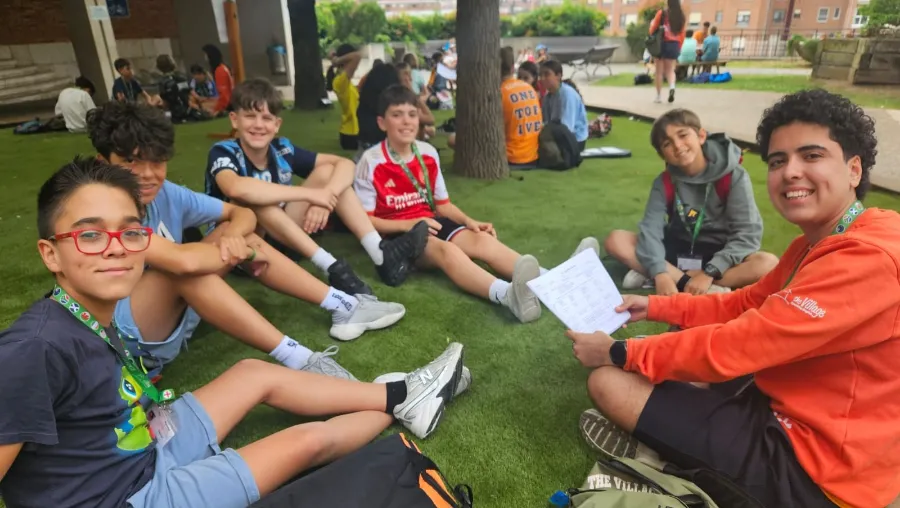
24-hour cohabitation in English: where learning really takes hold
A clear sign of quality is that immersion does not end when an activity is over. When adults keep English as the language of daily life throughout the day, the language becomes functional and natural.
For a child, this means that:
- English is used to solve small conflicts.
- It is used to ask for help, make friends or join in games.
- It is integrated unconsciously into daily routines.
This 24-hour English cohabitation is only possible when the adult team understands their role as a constant companion, not an occasional supervisor.
Structure versus improvisation: why “activities in English” are not enough
Another aspect that many parents overlook is the difference between improvising activities in English and following a clear pedagogical structure. A well-designed camp does not leave learning to chance.
The structure is evident in:
- How new expressions are introduced naturally.
- How they are repeated in different contexts throughout the day.
- How coaches know when to step in and when to give space.
When this work is backed by an educational method supervised by Cambridge University Press, adult support does not depend solely on each coach's personal experience, but on a common, coherent and tried-and-tested approach.
What signs indicate that adult support is working
As a parent, there are clear signs you can spot even in the first few days:
- Your child dares to speak even if they don’t know how to say everything.
- They say that adults help them to express themselves, not just to “correct”.
- They do not distinguish between “class” and “free time”: everything happens in English.
- They feel safe to take part without fear of making mistakes.
These signs are usually more reliable than any list of contents or commercial promise.

How all this fits into the overall evaluation of a camp
The role of the adult cannot be analysed in isolation. It is part of a wider set of criteria that determine whether an English camp offers real, sustainable learning.
For a complete view — including other key factors such as organisation, environment and the child’s experience — you can find more information in this guide on how to know if an English camp ensures real learning.
Choosing wisely: the adult as the basis of the experience
In camps aimed at children, the adult is not a secondary element: they are the axis around which immersion, emotional security and language progress revolve.
If you are considering different options and want to understand how a camp model is organised where coaches support children in English throughout their daily life together, you can find more information at an immersion programme based on international cohabitation, supervised educational method and continuous use of English.