

There is a word that appears on almost every English camp website: immersion.
It is used so often that, for many families, it has lost its meaning. Everything seems immersive at first glance, but if you scratch beneath the surface, doubts arise: is it really an experience in English or just a set of activities with some added classes?
This confusion is no accident. Immersion is not something that can be easily measured from the outside, nor can it be summed up in a number of hours. It is felt in how day-to-day life is lived and, above all, in what happens when there is no “official” activity taking place.
Understanding this difference is key to making the right choice.
When the word “immersion” is used for everything
Nowadays, practically any camp that includes English in its programme presents itself as immersive. Sometimes it’s enough that there are monitors who speak English, or that there are workshops in that language, for the term to appear in the description.
The problem is that this label does not always reflect the participant’s real experience. In many cases, English is concentrated in specific moments of the day and disappears as soon as the scheduled activity ends. Outside of that space, life together returns to the usual language and English becomes something occasional.
For a family looking for more than just summer classes, this difference is fundamental. Not because one model is “wrong”, but because not all of them meet the same expectations.
The language outside the schedule changes everything
The first clear sign of real immersion is not in the activities, but outside of them. It’s in the language used to organise groups, during meals, in downtime, or in spontaneous conversations.
When English remains present in these moments, it stops being a subject and becomes a practical tool. Participants use it to understand each other, to relate, and to be part of the group. Not because someone is making them, but because they need it to get by.
On the other hand, when English is limited to very specific time slots, learning often stays on the surface. There may be well-designed, even fun, activities, but the language never quite becomes integrated into the overall experience.
The difference between these two models is not always explained clearly, but it is quickly noticed when you observe how the camp is lived beyond the official programme.
When English becomes the language for living together in the Village
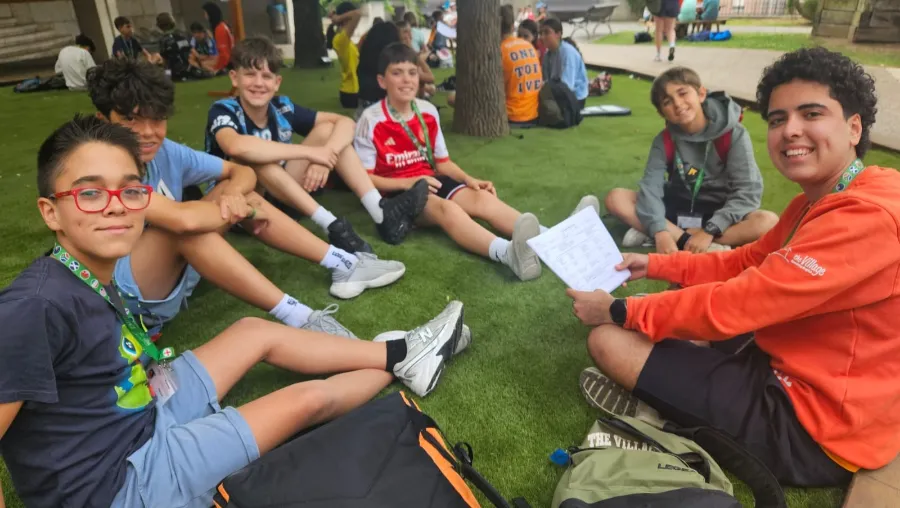
In the Village, the difference doesn’t start in a particular activity, but in how the day is lived from the moment participants wake up. English is not “activated” at specific hours: it is the language used to organise groups in the morning, explain what happens after breakfast, or solve any everyday situation that arises throughout the day.
When activities are prepared in the natural environment — a team-building exercise outdoors, a cooperative game in the woods, or a creative workshop — the instructions, conversations, and decisions are made in English. The same happens in less visible moments: handing out materials, waiting for a turn, talking about how an activity went, or sharing free time with the group.
This constant use means that the language stops feeling like something separate from the camp. Instead of “doing English”, participants use English to be part of what is happening. Little by little, even those who arrive feeling less confident start to speak without overthinking, to make mistakes without freezing up, and to communicate more naturally.
Immersion is not forced. It is sustained because English is the usual way of living together.
How English is experienced in the everyday life of the camp
On a normal day in the Village, English appears in very concrete and real situations. During adventure and sports activities, teams have to coordinate, encourage each other, and make decisions in English. In creative workshops, the language is used to explain ideas, share results, and work together. In social times, conversations arise spontaneously, with no script and without constant correction.
The role of international coaches is key. They do not act as teachers or distant figures, but as companions who take part in camp life. They are present in activities, meals, journeys, and downtime, naturally and closely maintaining English as the common language.
The Village’s setting, in the heart of nature, reinforces this dynamic. Outdoor activities, group living, and the absence of artificial routines make communication necessary. English becomes the tool for relating, collaborating, and enjoying the experience, not an imposed goal.
These situations are not always reflected in a timetable nor can they be summed up in a list of activities, but they are what make it so that, by the end of camp, many participants have gained fluency, confidence, and a much more natural relationship with the language.
Why not all camps can sustain real immersion
Sustaining real English immersion throughout a whole camp is not easy. It doesn’t just depend on speaking the language, but on being able to maintain it in everyday life without it feeling forced or exhausting for participants.
In experiences like the Village, this is possible because the entire model is designed from the outset for English to be the language of interaction. The international team does not come and go, but lives with the participants. The activities are not designed as “disguised classes”, but as experiences that require real communication: team games, outdoor challenges, creative dynamics, sport, and time spent together in a group.
The setting also plays a decisive role. Living the camp in the heart of nature, far from the usual routine, makes it easier for participants to get more involved in what is happening and less in what is going on outside. As there is no clear separation between activity, living together, and free time, the language is maintained constantly and naturally.
That’s why real immersion is not advertised nor measured in hours. It is perceived in how participants talk to each other, in how they organise themselves, and in how they gain confidence as the days go by. When the model works, English stops being something that is “practised” and becomes part of the experience.
Choosing a camp with real immersion is not about picking the one that promises the most, but the one that has built an environment where the language can truly be lived, from morning to night, without needing to be reminded at every moment.