


When the time comes to decide how to make the most of summer to improve English, many parents ask themselves the same question: is it better to send my child to a camp abroad, or can they achieve similar results in Spain? For years, the idea has taken root that going abroad automatically guarantees better immersion, but the reality is far more nuanced.
The difference lies less in the country and more in how the environment is designed. There are experiences abroad that generate very little real speaking and, at the same time, programs in Spain that manage to turn English into the natural language of daily life. Understanding these differences is key to choosing wisely and avoiding disappointment.
Do you really learn more English abroad?
It’s a widespread belief that simply crossing a border multiplies language learning. However, traveling abroad does not in itself guarantee effective language immersion.
The country does not guarantee immersion
A camp abroad can fall short if the program design does not require real use of English. If the child or teenager is mainly surrounded by other Spanish participants, if the language is limited to specific classes, or if counselors constantly translate, the environment stops being immersive—even if it’s outside Spain.
The key is not where you sleep, but which language you live in every day.
Language immersion vs. activities in English
There is an important difference between taking part in activities in English and living in true language immersion. In the first case, the language appears at specific moments; in the second, it becomes the necessary tool to interact, live together, and solve everyday situations.
A well-designed program in Spain can generate more real speaking than a poorly structured program abroad. What makes the difference is whether English is optional or essential to being part of the group.
Real advantages of going abroad
That said, traveling abroad can offer significant benefits when the experience is well designed and adapted to the participant’s profile.
Independence and cultural exposure
Leaving one’s usual environment often encourages independence. A change of country, habits, and routines pushes children or teenagers to adapt, make decisions, and gain autonomy. For some profiles, this cultural exposure is very positive and accelerates personal growth.
Continuous social context when well structured
When a camp abroad brings together participants from different nationalities and English is the group’s common language, the language is used constantly and naturally. In these cases, daily life encourages real conversations throughout the day, not only during structured activities.
It’s important to note that this does not always happen. It depends greatly on the diversity of the group and how daily life is managed.
Distance as an emotional factor
Distance can work for or against the experience. For some children and teenagers, being far from home facilitates disconnection and full immersion. For others—especially during first experiences or at younger ages—it can create anxiety and make it harder to make the most of the program.
That’s why going abroad is not automatically better, but rather more suitable for certain profiles.
Risks and weak points of camps abroad
Although traveling abroad can be very enriching, it also involves risks and limitations that are not always clearly explained. Taking these into account is essential to making a realistic decision.
Highly variable supervision and standards
Not all countries or programs operate with the same standards of supervision, safety, or support. While some camps have well-defined protocols, others grant significant autonomy from an early age.
For some teenagers this may be positive, but for children or first-time participants, insufficient supervision can lead to insecurity, isolation, or poor adaptation, directly affecting language progress.
Communication with families and incident management
Geographical distance and language barriers can complicate communication with families. In the event of health, adaptation, or social issues, response times are often longer and the sense of control is lower.
For many parents, this uncertainty weighs more heavily than the supposed linguistic benefit of going abroad, especially when we are talking about children or teenagers who have never been away from home on their own.
Real cost beyond the base price
The initial price of a camp abroad rarely reflects the total cost. Beyond the base program, families must add flights, transfers, extended medical insurance, unexpected expenses, and sometimes optional activities that are paid separately.
When analyzing the real cost, the economic difference compared to other options can be considerable—and it does not always translate into a better immersion experience.
The biggest risk: grouping with other Spanish participants
One of the most common issues is that Spanish participants tend to group together. This is natural: sharing language and cultural references provides security, especially in the first few days.
However, when this happens consistently, English stops being the language of daily life. Even if the camp is abroad, immersion fades and real speaking drops dramatically.
Real advantages of an international camp in Spain
Contrary to the idea that Spain is always a “lesser” option, there are well-designed international programs that offer clear advantages, especially at certain ages or for specific profiles.
Greater logistical and health security
Staying in one’s own country makes it easier to manage any medical or emotional issues. Health protocols are usually more accessible, communication with families is smoother, and the sense of control is greater.
This allows many children to relax sooner and focus on the experience—especially important at younger ages.
Better adaptation in first experiences
For children who have never attended an international camp or who are separating from home for the first time, a familiar environment reduces initial stress. This smoother adaptation often translates into a greater willingness to communicate and participate.
When a child feels safe, language learning flows more naturally.
When there is international coexistence, English can be the common language
The key lies in daily coexistence. If the program brings together participants from different nationalities and English is the shared language, it naturally becomes the tool for interaction—even in Spain.
In these cases, the environment can be just as immersive as many camps abroad, with the added advantage of simpler logistics.
What really makes the difference when choosing
After comparing Spain and abroad, the key conclusion is this: you are not choosing a country, you are choosing an environment. And when the environment is well designed, English stops being an activity and becomes the natural way of living together.
Ratio and real speaking opportunities
If a child has few opportunities to speak, there will be no real progress. The ratio matters because it defines how many real interactions they will have each day. The smaller the group and the closer the support, the easier it is for children to open up and for teenagers to stop “overthinking” and start speaking.
Language policy in daily life
Immersion is not decided in a classroom; it is decided in daily life. The key question is not how many hours of English are “taught,” but which language is used at meals, during games, in free time, or when a conflict arises. That is where real speaking is built.
Real diversity of nationalities
“International” is not a label—it’s a daily reality. When young people from different countries live together, English becomes the group’s common language. And when English is the language of the group, speaking it stops being an effort and becomes normal.
Supervision, protocols, and wellbeing
For a child to dare to speak, they first need to feel safe. Safety is not only medical—it is emotional. A well-supervised environment, with present adults and clear routines, reduces anxiety, improves adaptation, and makes it easier for language to emerge.
Communication with families
When parents feel at ease, children do too. Knowing how communication with families is handled, what happens in case of an incident, and how adaptation is supported is a real part of the decision—not a minor detail.
Type of activities and their purpose
Activities should not be “filler.” The best experiences are those that require interaction: team challenges, creative projects, cooperative sports, and social dynamics. These are the moments when language is used with real purpose.
Profile and maturity of the child or teenager
Not all children need the same level of challenge, and not all teenagers benefit from the same experience. For some, the ideal first step is a well-supported international experience; for others, an adventure far from home may be too soon. Choosing well means adapting the experience to the child’s stage of life.
Kids vs Teens: which option makes more sense depending on age
Kids (8–12 years old)
For Kids, adaptation and safety matter most. A well-designed international environment in Spain is often an excellent option because it provides strong immersion without adding extra difficulty (travel, cultural shock, distance). If English is lived in daily coexistence and there is real diversity, progress can be very fast—especially in confidence and comprehension.
Teens (13–17 years old)
For Teens, the social factor is decisive. When teenagers live with peers from other countries and English is the group’s language, it stops being “a school subject” and becomes a social tool. If the environment is also well structured and supported, the leap in speaking is usually much more visible.
So, camp in Spain or abroad?
The right decision is not “outside or inside,” but “what experience does my child need right now?”
If the goal is to speak English with confidence
Prioritize experiences where English is the language of daily life, there is genuine international mix, and continuous speaking throughout the day.
If the goal is a full life experience
Going abroad can add significant cultural and independence value—but only if the program is well structured and the child or teenager is ready for that distance.
If it is the first step before going abroad
An international camp in Spain can be the perfect transition: less friction, more security, and the opportunity to experience real immersion without depending on the destination.
Frequently asked questions about camps in Spain and abroad
At what age is it advisable to travel abroad for the first time?
It depends more on maturity and previous experience than on age itself. For many children, a well-supported international experience in Spain is a very smart step before going abroad.
Is it possible to experience real language immersion in Spain?
Yes—as long as the environment is designed so that English is the natural language of daily life and there is real diversity of nationalities, not just “activities in English.”
What if my child groups with other Spanish participants?
This is common at the beginning. The key is whether the program is designed to mix groups, encourage international coexistence, and maintain English as the common language. If not, immersion is lost—even abroad.
Is a camp abroad always better?
No. There are experiences abroad with very little real immersion and programs in Spain with a far stronger international design. The country is not the decisive factor.
How much does a camp abroad really cost?
In addition to the base price, you must add flights, transfers, insurance, extras, and unexpected expenses. It’s important to compare the real cost with the real value of the experience.
Which option is better if my child is shy about speaking English?
Environments with small groups, close support, international coexistence, and a culture where making mistakes is normal tend to work best. That’s where children open up and teenagers stop blocking themselves.
Are two weeks enough to see results?
Yes—if immersion is continuous and real. When English is lived all day long, the change in confidence and fluency can be clearly noticeable even in relatively short periods.
Why the Village is the logical choice if you are looking for real immersion in Spain
If you’ve read this far, you already have the most important criterion: it’s not about choosing a destination, but about choosing an environment where English is inevitable, natural, and constant. And that is precisely what sets the Village apart.
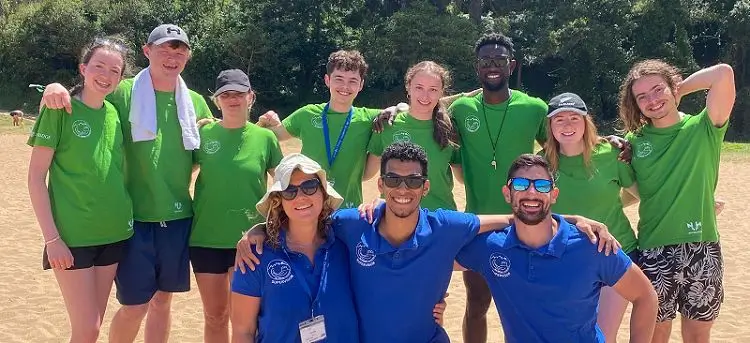
the Village is designed as a truly international camp in Spain, where Kids and Teens live alongside participants from multiple nationalities and English is the language of everyday life. It is not “a camp with activities in English.” It is an environment where English is used to live: to make friends, work as a team, take part in academies, handle everyday situations, and gain confidence through speaking.
Additionally, being in Spain combines that international immersion with simpler logistics and a safety and communication framework with families that many parents particularly value—especially in first experiences.
If your goal is for your child to stop “knowing English” in theory and start using it naturally, this is the kind of experience that marks a before and after. The Village does not compete with “Spain vs abroad.” It competes with the real question: do you want a summer truly in English, or just a summer with some English?