

If it's your child's first time attending an English camp, the first few days may raise some doubts: "Are they really learning or just having fun?" The good news is that, without waiting for the end of the camp, there are early signs that help you detect whether the experience is building real and sustainable learning.
If you want to assess with criteria whether an English camp is going to deliver real results, the first days are key. In this guide we focus on which early signals to look out for during the initial phase of the experience, something especially important for parents facing this type of camp for the first time.
Why the first days are so revealing
In a camp with genuine immersion, learning does not depend on "giving lessons" from minute one. It depends on creating an environment where English is the natural tool for living together, playing, problem solving and socialising. That's why the most reliable signs at the start are not "how many worksheets they do", but rather how their behaviour changes and how the camp is organised to sustain immersion.
Early signs (first days) that point to real learning
1) English appears outside of a "lesson time"
One of the clearest signs is that English is not limited to a set time slot. If the camp is working, your child will start using short and functional expressions in real situations: in the dining hall, preparing an activity, during sports or when asking for help.
- Uses simple phrases for everyday needs ("Can I…?", "I need…", "Where is…?").
- Imitates expressions from the coaches without being prompted.
- Connects English with actions (play, sport, living together), not just with "studying".
2) There is “healthy resistance” to Spanish, without pressure or punishment
Real immersion is based on a simple rule: do not use Spanish. But the difference is in how it's applied. If your child tells you that "they help them say it in English" and that they are guided with patience, that's a positive sign. If they convey embarrassment, tension or fear of making mistakes, that dynamic usually does not support real learning.
- Corrections are made naturally, prioritising communication.
- Alternatives are offered ("Try saying it like this…") instead of reprimands.
- The child dares to speak even if they make mistakes.
3) Your child starts to “think in English” in micro-moments
In the first few days, don’t expect long speeches. What is very revealing is the change in "mental mode": recalling a single word, asking for something in English without translating first, or responding to an instruction without needing a Spanish explanation.
- Responds to simple instructions in English without waiting for a translation.
- Remembers vocabulary associated with routines or games.
- Tells you that "in the end it just comes out" at certain times.
4) You notice an environment with different accents and cultures (and that speeds up adaptation)
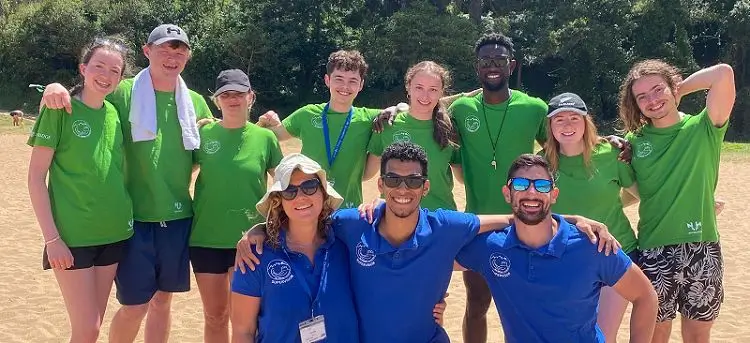
Living with international, multi-accented coaches creates a real context: English stops being "the teacher's voice" and becomes a living language with nuances. If the camp brings together up to 12 nationalities, it’s normal for your child to mention different accents, new expressions, or curiosity about how each person speaks. That early exposure is a strong indicator of authentic learning.
- The child realises that "not everyone speaks the same" and still understands.
- Begins to normalise English as a social language.
- Lowers the barrier to making mistakes by comparison with "perfect English".
5) Supervision and support are present in every activity (1:5 ratio)
For real learning to occur, a camp needs the child to speak, not just "listen to English". An early sign of quality is the team's ability to provide close support during activities, dynamics and daily life. A 1:5 ratio in all activities usually allows for natural corrections, real conversation, and immediate support when shyness or frustration arises.
- The child receives real attention during activities, not left "lost" in a large group.
- The coaches can encourage participation without forcing it.
- There are more opportunities to speak, ask questions and repeat in context.
6) Your child tells you about small "victories" (more important than a vocabulary list)
In the first days, learning is measured in confidence and functionality: understanding an instruction, asking for something, making a friend, laughing in an English game. If you start hearing about this kind of progress, it's a very reliable sign.
- "Today I understood a game without anyone translating it for me."
- "I spoke to a coach and they understood me."
- "I teamed up with someone and we had to speak English."
Warning signs in the first days (and what they mean)
Not everything that's "hard" is negative: adaptation can include tiredness, homesickness or shyness. But there are signs that, if repeated, may indicate that the camp is not creating a real immersion environment.
- Spanish dominates daily life: if your child tells you that "almost everyone speaks Spanish all the time", immersion weakens and real learning usually drops.
- English is reduced to "classes": when outside the classroom everyone switches back to Spanish, English is just another subject, not daily life.
- The child feels pressured to speak perfectly: if there is fear of making mistakes, progress slows down.
- Groups too large without support: less real interaction, fewer opportunities to speak.
How to interpret what your child tells you without jumping to false conclusions
First-time parents often look for immediate proof ("Have they learned yet?"). In a well-designed camp, the first days are for adjustment: English starts with short phrases, routines, instructions and social dynamics. The key indicator is not the amount of "studied" content, but the frequency of real use.
If you want a practical way to evaluate, use these questions:
- At what times of the day do you use English without realising?
- Do you feel more able to ask for things or join in?
- Do you feel that English is "in the environment" all the time?
- Do they help you say it in English when you don't know a word?
What to expect if the camp is really good
In a camp with real immersion, this usually happens:
- Day 1–2: adaptation, shyness, very short phrases, lots of functional language.
- Day 3–4: more participation, more understanding, first simple conversations with coaches.
- Day 5 onwards: boost in confidence, more spontaneous use, less mental translation.
It's not a rigid rule, but it is a common pattern when there's a constant English environment, close support (1:5 ratio), no use of Spanish and international, multi-accented cohabitation.
Conclusion: the important thing is not to “see results” in 48 hours, but to spot the right path
If in the first days you see English appearing outside the classroom, Spanish not dominating, your child daring to communicate even if they make mistakes, and real support in activities (1:5 ratio), you have very strong signs that the camp is building authentic learning.
If you want to broaden your perspective and understand all the criteria that influence real learning in an English camp — beyond the first few days — you can check out this comprehensive guide on how to tell if an English camp ensures real learning.
If you are considering an English camp for your child and want to understand how real immersion is built from day one, it's important to review how daily life, support and the language environment are organised. On this page you can find detailed information on a camp model based on daily immersion, exclusive use of English and international cohabitation.